Where reliability is required
Industrial, Oil & Gas Market
Advanced, rugged, reliable technology when there is no time for downtime. Confidence when and where it counts: downhole, pipeline, subsea and other demanding applications.
Built on Trusted Industry Expertise
In industrial and oil & gas environments, ruggedized solutions are the standard. Applications such as downhole tools play a critical role in exploration, drilling, and production operations. These systems require reliable power for communications, sensors, and other electronics, and in many cases battery power is the only practical option.
By combining Ultralife’s mission-critical power expertise with the battery and oil & gas heritage of Electrochem, Excell Battery, and Southwest Electronics (SWE), we provide customers with advanced technologies, expanded engineering capabilities, and integrated power solutions.
We offer a wide selection of standard cells, batteries, and battery packs that can be readily integrated into new or existing applications.
We also serve as an engineering partner, designing, qualifying, and manufacturing custom energy and communications solutions for the most demanding industrial and oil & gas applications.
Unforgiving Environments, Demanding Applications
Ultralife supports your needs for:
Industrial and oil & gas operations demand power solutions capable of performing in extreme temperatures, high pressures, hazardous locations, and remote environments where safety is paramount and failure is not an option.
The Power of Vertical Integration
Our integrated global operations enhance agility, resiliency, and customer support through expanded engineering and product development resources, stronger supply chain management, manufacturing redundancy, and advanced testing and quality capabilities; helping ensure reliable performance in the world’s most demanding environments.

Custom Power Starts with Your Application
We believe a successful battery or power system design begins with the operating profile, not a catalog part number.
Ultralife engineers evaluate voltage, current demand, pulse load, runtime, space envelope, operating and storage temperature, safety requirements, shipping classification, certifications, and total lifecycle requirements. For lithium thionyl chloride systems, for example, cell or pack configuration, temperature range, current rate, capacity, available space, safety, UN shipping requirements, quality certifications, cost, and availability are all key selection factors.

From there, the design can be optimized around:
Our Engineering Process:



Featured Products
Trusted battery technologies engineered for demanding downhole and subsea environments.
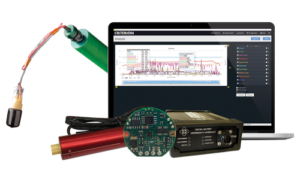 Criterion™
The World’s Most Advanced Battery Monitoring
We designed our hardware and software from the ground up to meet the needs of our clients. The goal of our software was to produce a clean and intuitive interface that allows the user to access and manipulate their data effortlessly. Our hardware was built to be the most reliable, repeatable and accurate battery monitor on the market.
Criterion™ App
New generation of advanced battery monitoring system providing users with the capability to record battery usage and the ability to analyze downhole conditions.
Compact Field Reader
Ruggedize your workflow. The new EFR100 compact field reader allows you to check your remaining battery life in the field or warehouse quickly, with no computer setup needed.
Criterion™ Gauge Key Features
- Temperature rating: -40°C to 180°C
- Live inclination reporting
- Customizable warning flags and thresholds
- Variable logging rates to maximize your available data capacity
- Job tagging to limit downloads to specific jobs
- Accurate battery life measurement
- Optional Powerline Modulation (PLM) support
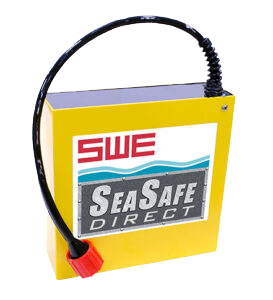 SeaSafeTM Autonomous Battery Modules
They provide reliable, high-performance lithium-ion power for underwater vehicles, oceanographic systems, and subsea equipment. Designed for demanding marine environments, the product line offers pressure-tolerant options tested to depths of 6,000 meters, flexible 24V, 30V, and 37V configurations, advanced battery management, and up to four times the runtime of sealed lead-acid batteries.
High Performance
- 4X Longer Run Time Endurance (vs SLA)
- 100% Condition Based Monitoring
- High Current, High Power Versions
- 10 AMP
Lower Risk
- ABS Certified & 2nd Generation Learned
- 6000M Pressure Tolerant Tested
- UN 38.3 Certified and Safety Tested
- ISO 9001 Quality Manufactured
- 40 AMP
Patented Battery Management System
- Automatic Cell Balancing
- Automatic Module-to-Module Balancing
- Continuous, Redundant Safety Protection
- Ability to Balance High Capacity Packs
- Subsea Application Proven
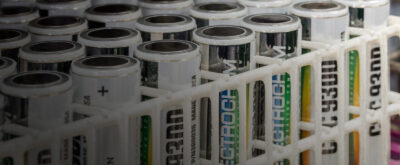 Ultralife’s Electrochem Cells
Custom power solutions for critical applications where energy demands are high, operating conditions are extreme, and the cost of failure is significant.
Lithium Thionyl Chloride (Li/SOCl₂) Electrochem Cells
Ultralife’s Lithium Thionyl Chloride (Li/SOCl₂) Electrochem cells are designed for applications requiring maximum energy density, extended service life, and dependable operation. Available in bobbin, dual-anode, and spiral-wound constructions, these cells provide reliable power for long-duration applications operating in challenging environments.
Lithium Bromine Chloride (Li/BCX) Electrochem Cells
Ultralife’s Lithium Bromine Chloride (Li/BCX) Electrochem cells are engineered for applications requiring exceptional pulse capability, high-rate performance, and dependable operation in extreme environments. Utilizing advanced spiral-wound construction and proprietary electrolyte technology, these cells deliver the power, responsiveness, and reliability needed for critical applications.
Sulfuryl Chloride (Li/SO₂Cl₂) Electrochem Cell
Ultralife’s Lithium Sulfuryl Chloride (Li/SO₂Cl₂) Electrochem cells are designed for applications requiring high energy density and high-rate performance. Featuring advanced spiral-wound construction and proprietary electrolyte formulations, these cells deliver dependable power in demanding environments. Engineered to minimize passivation, they support both high pulse and continuous current requirements.